
A solar cell submerged in seawater sounds like a dead end. Sunlight fades fast below the surface, and the red and infrared wavelengths that conventional silicon panels are built to absorb vanish within the first couple of meters. Yet a team led by researchers at Yunnan University has now shown that perovskite solar cells can operate reliably 10 meters (33 feet) down, generating useful power in the dim, blue-shifted light of the South China Sea.
Here is the twist that makes the result genuinely surprising: in lab tests mimicking light at that depth, the same cells converted 34.71% of the incoming light into electricity, roughly double their efficiency under ordinary sunlight. For the right kind of cell, water is not just a barrier. It is a better operating environment.
The study, published in the journal Joule on September 11, 2026, is the first functional validation of underwater solar cells at a depth that matters for real applications. Every previous attempt topped out in water two meters deep or shallower, where sunlight is plentiful but practical uses are scarce. This article breaks down how the cells work, what the field test showed, and how close the technology is to powering the ocean’s growing network of sensors and robots.
Why Solar Power Has Stopped at the Waterline
The ocean runs on batteries. Underwater sensors, cameras, acoustic modems, and autonomous vehicles monitoring aquaculture, reefs, pipelines, and deep-sea mining operations all draw power from battery packs that must be swapped by ship or recharged through expensive cables running to shore.
Short battery endurance is the long-standing bottleneck for underwater devices, and retrieving a sensor just to change a battery can cost more than the sensor itself.
Researchers have tried creative workarounds, including a battery-free underwater camera powered by sound waves and kinetic harvesters that feed off currents. Sunlight, the most abundant energy source on the planet, has largely been written off because of how water treats it.
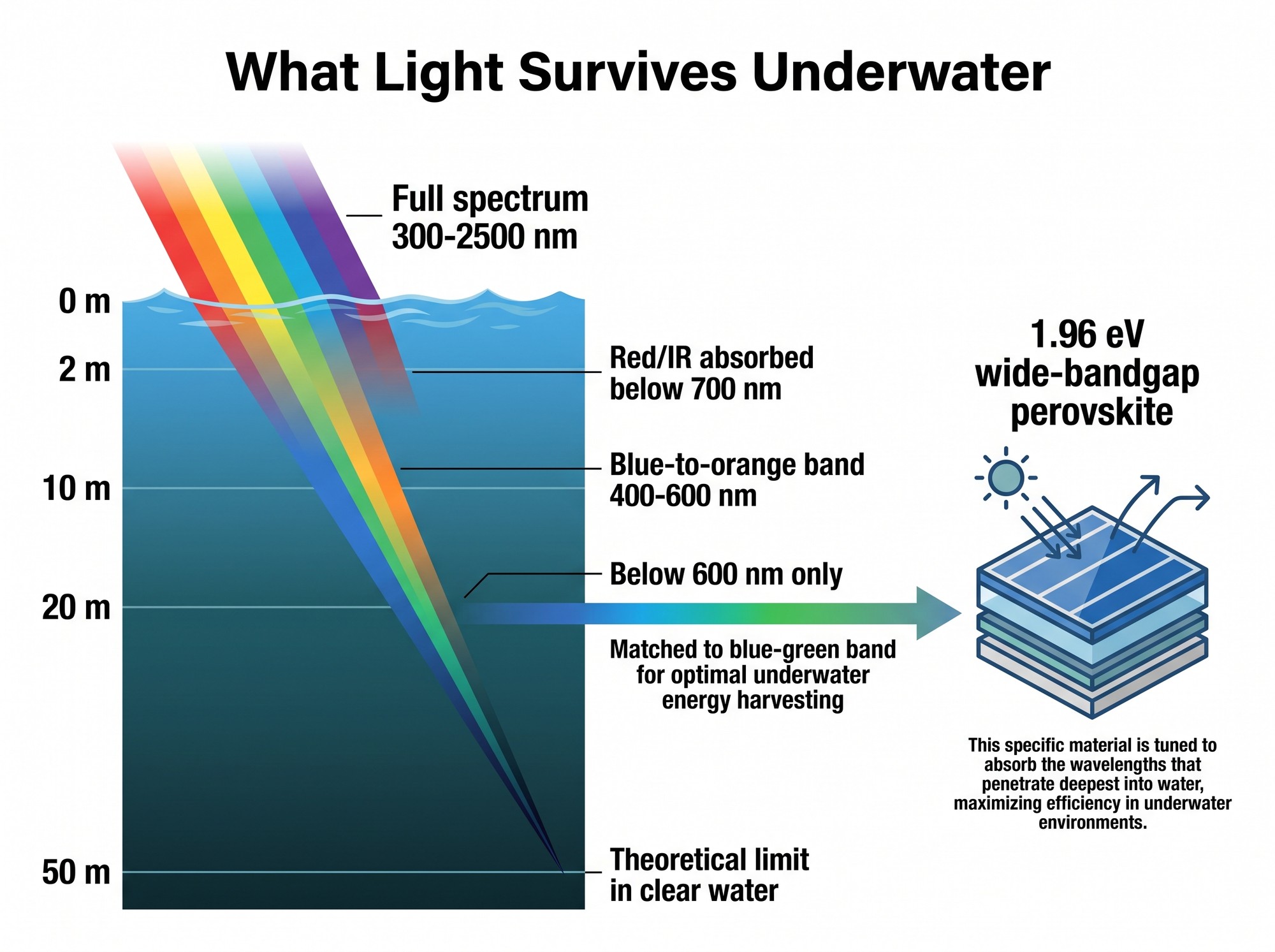
Seawater acts as a ruthless optical filter. Below two meters, almost all light with wavelengths longer than 700 nanometers is absorbed, and by 10 meters the surviving spectrum is a narrow blue-to-orange band, roughly 400 to 600 nanometers. A standard silicon solar cell, tuned for the full terrestrial spectrum, loses most of its useful output in that environment. Building a working underwater solar cell is therefore less about waterproofing a rooftop panel and more about re-engineering the cell around a completely different kind of light.
A Solar Cell Tuned to the Light That Reaches 10 Meters
That is exactly what the team did. In a paper led by Simin Ma and senior author Wen-Hua Zhang, the researchers built a wide-bandgap lead halide perovskite cell with a bandgap of about 1.96 electron volts, matched to the blue-green light that survives at depth. Perovskites are a class of crystalline materials whose bandgap can be tuned by adjusting their composition, which makes them unusually well suited to chasing a narrow slice of the spectrum.
The choice of bandgap was not a guess. A 2020 analysis in the journal Joule calculated that underwater photovoltaics could remain useful at depths approaching 50 meters in exceptionally clear water, provided the cells used wider-bandgap materials, with an optimal bandgap near 2.1 electron volts at intermediate depths. The cells just field-tested at 1.96 electron volts land remarkably close to that prediction, which is a strong sign that the theory of underwater photovoltaics is holding up in practice.
Because standard terrestrial test conditions are meaningless underwater, the team also built a custom underwater solar simulator with tailored optical filters to reproduce the spectra found at various depths.
Under standard AM1.5G sunlight, the small cells are certified at about 17% efficiency. Under the simulated 10-meter underwater spectrum, the same cells hit 34.71%, and scaled-up large-area modules reached 29.4%. The team also managed the difficult step of scaling from small-area laboratory cells to large-size modules, the milestone that separates a lab curiosity from a deployable device.
The South China Sea Field Test: 324 mWh From the Deep
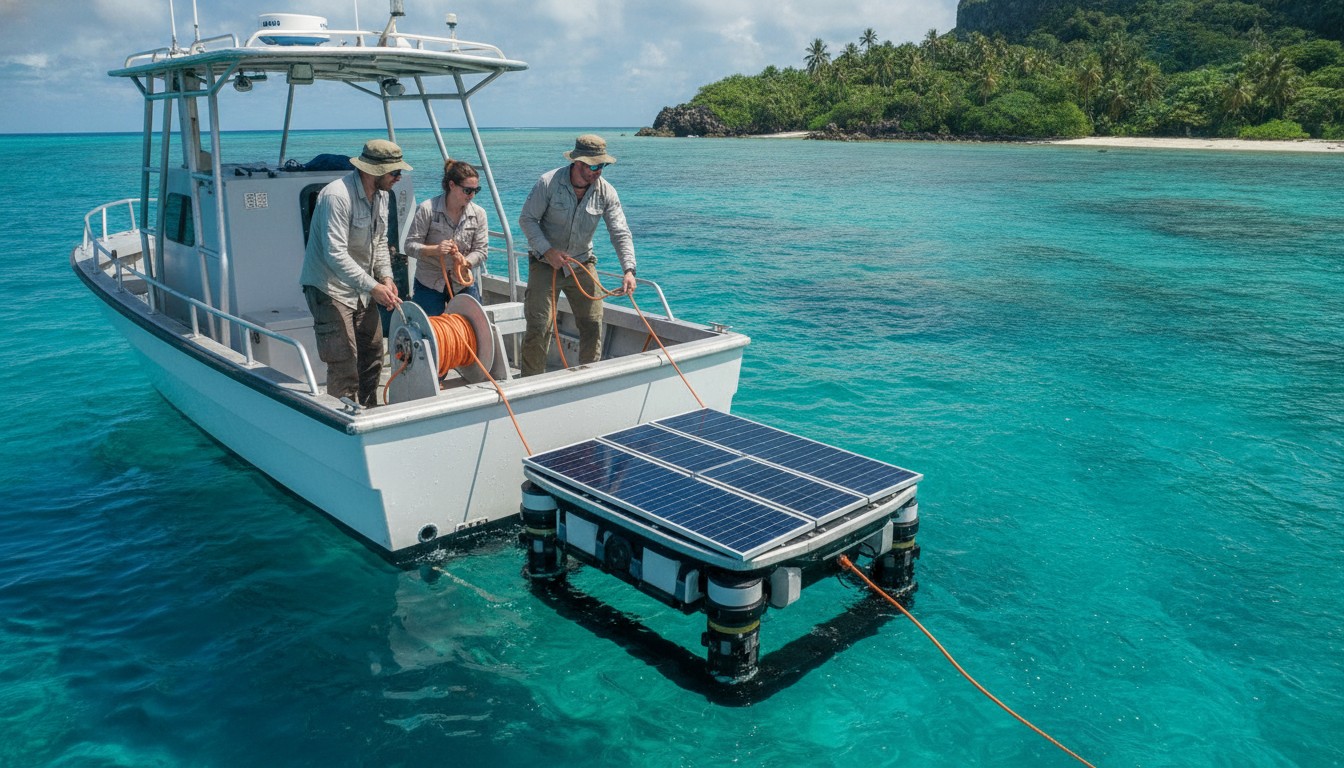
Lab spectra are one thing; the sea is another. To close that gap, the team integrated the perovskite modules with underwater robots and deployed them at a depth of 10 meters off the Weizhou Islands in the South China Sea.
Over just two hours of submerged illumination, the large-area modules generated 324 milliwatt-hours of electricity, enough to recharge standard lithium-ion batteries and, in the researchers’ demonstration, later power an LED panel. That may sound modest, but it is the right order of magnitude for the low-power sensors and communication hardware that make up the Internet of Underwater Things.
Durability figures may matter even more than the headline output:
- Almost zero degradation over 1,160 hours of operation at a simulated 10-meter depth.
- Roughly 96% of efficiency retained after 300 days of storage.
- An estimated continuous operational lifespan of about 5.5 years at the 10-meter depth.
“What surprised us most was so much electrical energy our large-area modules generated under real-world conditions at 10-meter water depth for only two hours,” Zhang said, adding that the combination of laboratory investigations and field experiments “provides strong evidence for the operation of underwater photovoltaics.”
The Ocean Boost: Why Water Makes Some Solar Cells Better
The most counterintuitive result in this field is that solar cells can be more efficient underwater than on land, and it is worth understanding why. Three effects stack up in the cell’s favor.
- Spectral filtering. Water strips out the infrared and red light that a wide-bandgap cell cannot convert efficiently anyway, handing the cell a spectrum pre-filtered to match its bandgap. The mismatch losses that plague terrestrial operation largely disappear.
- Cooling. Solar cells lose voltage as they heat up. Submerged cells are held at a stable, cool temperature by the surrounding water, trimming thermal losses that rooftop panels suffer every sunny afternoon.
- Reduced reflection. Research published in 2025 showed that perovskite cells gain conversion efficiency within the first centimeters of water, because water’s refractive index cuts the light that would otherwise bounce off the cell surface.
The Yunnan team’s cells are not the only beneficiaries. A 2022 study in iScience found that gallium indium phosphide cells, a wide-bandgap technology common in space satellites, outperform silicon below two meters and approach 54% efficiency under simulated underwater spectra. And 2025 work in PNAS showed that flexible amorphous silicon cells with the right curvature reached 59.7% efficiency at two meters, producing up to 15.9% more energy over a day than flat cells. Underwater photovoltaics is quietly becoming its own design discipline rather than a matter of dunking land panels in the sea.
How Deep Can Underwater Solar Cells Go?
Ten meters is a record for a functional device, but it is not a physical limit.
Depth determines what light remains, and what light remains determines what is possible.
| Depth | What survives of the sunlight | Implication for solar cells |
|---|---|---|
| Surface | Full spectrum, roughly 300 to 2,500 nm | Standard silicon works fine |
| 1 to 2 meters | Red and infrared sharply attenuated; almost nothing beyond 700 nm | Wide-bandgap cells start outperforming silicon |
| 10 meters | Narrow blue-to-orange band, roughly 400 to 600 nm | 1.96 eV perovskites validated in the field |
| 20 meters | Only wavelengths below about 600 nm | Even wider bandgaps favored |
| 50 meters | Very faint blue-green light in exceptionally clear water | Estimated theoretical ceiling for useful underwater PV |
Water clarity is the wild card. The 50-meter ceiling assumes oceanic clarity; in turbid coastal water, plankton blooms, or river estuaries, useful light disappears much closer to the surface.
The Yunnan team’s next step is to push deeper into the dark and map exactly where solar harvesting stops paying off while establishing standardized testing protocols so results from different labs can be compared.
Underwater Solar Cells vs. the Other Ways to Power the Seafloor
Submerged solar does not need to beat every alternative everywhere. It needs to win in the shallow, sunlit band where most marine monitoring happens and complement other methods at greater depths.
| Power option | Strengths | Limitations |
|---|---|---|
| Primary batteries | Simple, proven, any depth | Finite life; ship visits to replace them are expensive |
| Cables from shore | Unlimited power | Costly installation; anchors sensors to one spot |
| Acoustic power transfer | Works at range, no physical connection | Low power, needs a transmitting source nearby |
| Wave and current harvesters | Continuous in energetic waters | Moving parts, mooring complexity, site-dependent |
| Submerged solar cells | No moving parts; self-charging; 5.5-year estimated lifespan; silent | Limited to sunlit depths; output varies with clarity, weather, and season |
Kinetic approaches illustrate the trade-off. Underwater kite turbines generating electricity in the Atlantic deliver continuous output in energetic waters, but they bring moving parts, mooring hardware, and maintenance dives that a static, silent solar module avoids.
The winning architecture for many sites may be hybrid: a submerged solar module that keeps a small battery topped up during daylight hours, with the battery carrying sensors through the night. At 324 mWh in two hours, the demonstrated modules are already sized for that duty cycle.
Hurdles Between the Prototype and the Ocean Floor
The researchers are candid about what stands between a successful field trial and routine deployment. The main challenges include:
- Biofouling. Algae and barnacles colonize any submerged surface within weeks, blocking light. Anti-fouling coatings that stay optically clear for years are essential.
- Corrosion and sealing. Salt water, pressure, and water ingress attack encapsulants and electrical contacts. The cells need packaging that survives years of immersion, not weeks.
- Environmental variability. Clouds, seasons, turbidity, and depth all swing output, so systems must be designed around the worst weeks of the year, not the best hours.
- Perovskite stability. Lead halide perovskites are moisture-sensitive by nature. Encapsulation must be bulletproof, though supporting research found that a damaged perovskite device released minimal lead during a 10-day saltwater submersion test, within legal limits for drinking water.
- Standardization. There are no agreed testing protocols for underwater photovoltaics yet, making it hard to compare results across labs and manufacturers.
What Comes Next
The immediate roadmap is clear: test deeper, quantify how water clarity affects output, and build the standardized measurement framework the field lacks. Beyond that, the applications multiply quickly.
Self-charging sensor networks could monitor aquaculture pens, coral reefs, pipeline integrity, and water quality continuously, feeding data to the surface without battery-swap logistics.
Autonomous underwater vehicles could recharge at docking stations fitted with submerged modules instead of returning to a mothership. Silent, emission-free power with no moving parts is also attractive for long-term deployments near sensitive habitats, where the noise and risk of fuel-based generators or servicing vessels are unwelcome.

Underwater solar will not power the deep ocean; below roughly 50 meters, physics wins. But the sunlit upper layer is where the overwhelming majority of marine sensors, cameras, and robots operate, and that layer now has a credible, self-renewing power source. The ocean’s version of the rooftop solar revolution may have just found its silicon.
Frequently Asked Questions
Do solar panels work underwater?
Yes, though not the ones on your roof. Standard silicon panels lose most of their output underwater because they are tuned for red and infrared light that water absorbs. Purpose-built wide-bandgap cells, such as the perovskite devices tested at 10 meters in the South China Sea, are designed around the blue-green light that penetrates seawater and can be more efficient submerged than in open air.
How deep can underwater solar cells operate?
The current functional record is 10 meters (33 feet), set in 2026. Modeling published in 2020 suggests underwater photovoltaics could remain useful down to about 50 meters in exceptionally clear water, with the practical limit arriving sooner in murky coastal conditions.
Why are some solar cells more efficient underwater?
Water pre-filters sunlight into the narrow blue-green band that wide-bandgap cells convert best, keeps the cells cool so they suffer fewer thermal losses, and its refractive index reduces reflection off the cell surface. The result: about 17% efficiency in air versus 34.71% under simulated 10-meter light for the same cell.
Can underwater solar cells charge batteries?
Yes. In field tests, large-area modules produced 324 mWh in two hours at 10 meters deep, enough to recharge standard lithium-ion batteries and run low-power devices such as sensors, cameras, and LED displays.
Are underwater solar cells commercially available?
Not yet. The technology has moved from lab cells to large-area modules and open-sea field trials, but issues such as biofouling control, long-term sealing, and the lack of standardized testing protocols must be resolved first.


