
Picture a sample frame winched back onto deck after five months at 757 metres down. The water there is near 4°C. The pressure is about 75 times what we feel at the surface. On the frame, three thin squares of plastic film are almost gone. Beside them, identical films without one added ingredient sit nearly intact, with at most 3.4% weight loss. That contrast is the whole story of a new Nature paper on enzyme-embedded polyesters for accelerated biodegradation in the deep sea.
What the team actually did
A group led by QiuYuan Huang and Tadahisa Iwata at the University of Tokyo, with colleagues at JAMSTEC and Gunma University, mixed trace amounts of natural degrading enzymes directly into compostable polyester films during thermal processing. The films were 4 cm squares, 100 micrometres thick. The team also made microbeads. The work was funded under NEDO’s Moonshot programme.
A polyester here means a plastic whose long chains are joined by ester links, the same kind of link the enzymes know how to cut. A cutinase is an enzyme that breaks down cutin, the waxy coating on leaves. A lipase is an enzyme that breaks down fats. Both can also snip ester links in certain polyesters. The loading is given in wt%, which means weight percent, so 0.1 wt% is one gram of enzyme per kilogram of plastic.
Samples were deployed by the crewed submersible Shinkai 6500 at four depths from 757 m to 5,503 m for three to eighteen months. Matching samples sat at a JAMSTEC quay in water 2 to 6 m deep. To put those depths in human terms, 757 m is a few hundred metres past the limit of recreational diving and well into permanent darkness, while 5,503 m is deeper than most of the ocean floor.
How the vanishing trick works
The enzymes sit dormant inside dry plastic. Nothing happens while the product is in use in dry conditions. That quiet-until-wetted behaviour is what the team calls a switching function.
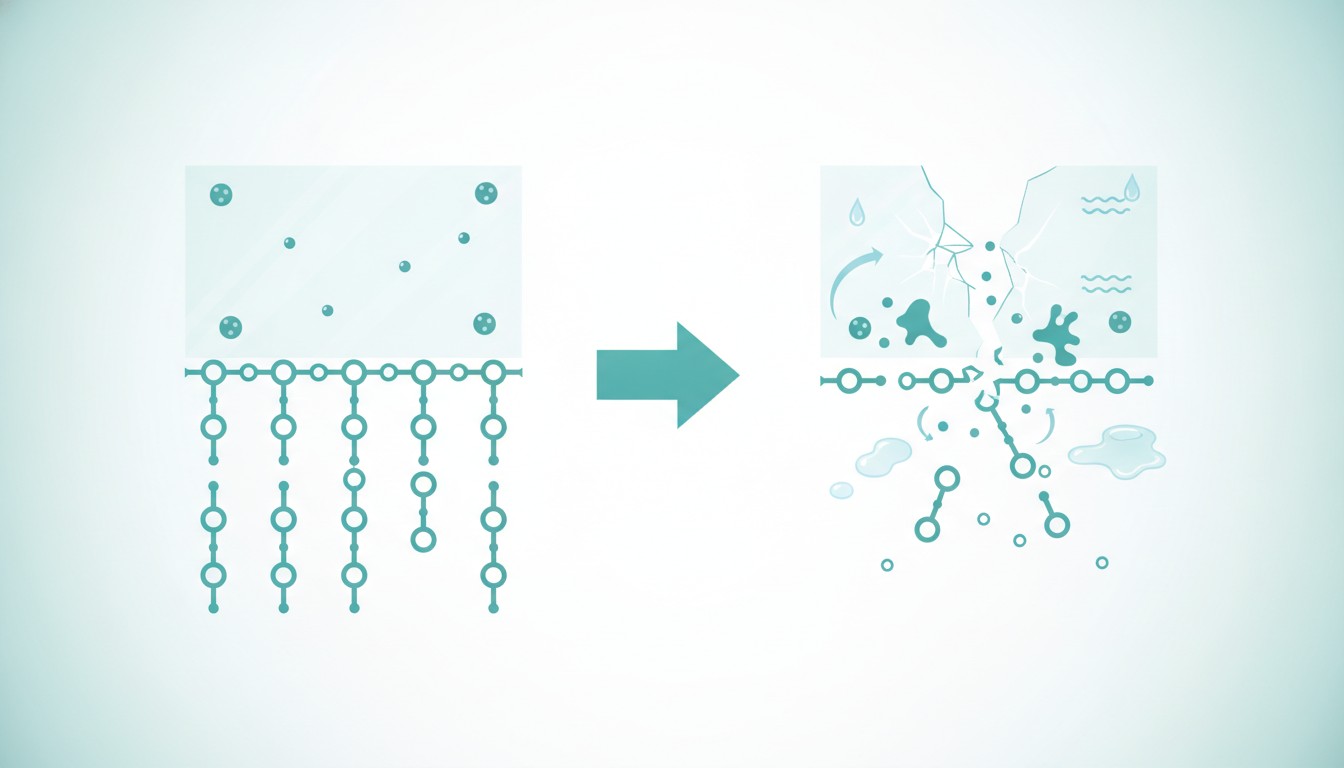
In practice it means this: once the material escapes into the environment and its surface is abraded or fragmented, water reaches the embedded enzymes, and they start cutting the surrounding chains from within.
This is a useful contrast with earlier compost enzyme plastics. Intelligent Living previously covered a compost plastic with built-in enzymes that break down in wet compost. The new work extends the same idea to cold, high-pressure seawater, where very few degrading microbes live.
Crucially, the enzymes are not alive, and they do not self-replicate. They are protein catalysts, present in tiny amounts, that speed a chemical reaction and are themselves eventually broken down.
What broke down, and how fast
At 757 m, films of HiC-embedded PBS, PBSA and PCL had nearly completely degraded within five months. HiC is Humicola insolens cutinase. PBS is poly(butylene succinate). PBSA is its adipate copolymer. PCL is polycaprolactone. All three are aliphatic polyesters, meaning their chains are flexible and relatively easy for these enzymes to attack.
The more recalcitrant aromatic polymer PBAT, which contains stiffer ring-shaped building blocks, also broke down faster with enzymes than without, but it did not vanish in the same way. That persistence echoes landfill leachate results where PBAT reached only 2.7% mineralization after 320 days. Five months is not instant, and faster for PBAT still leaves a polymer in the sea for a long time.
The overall acceleration at depth was 12 to 80 times faster than the same plastics without enzymes, depending on polymer and enzyme. At the quay, films broke down within one month, about 5 to 50 times faster than controls. Coastal trials showed very low loadings of 0.1 wt% were enough to drive rapid degradation and microbial mineralisation. Mineralisation means microbes convert the fragments all the way to carbon dioxide, water and biomass, rather than leaving microplastics behind.
| Deployment site | Time | Enzyme film result | Control without enzyme |
|---|---|---|---|
| Quay, 2 to 6 m | Within 1 month | Complete breakdown | Slow, 5 to 50 times slower |
| Off Misaki, 757 m | 5 months | PBS, PBSA, PCL near complete | At most 3.4% weight loss |
| Deep sites to 5,503 m | 3 to 18 months | Accelerated but only moderate at 5,503 m | Very slow |
Why the deepest site matters most
At 5,503 m, degradation was moderate rather than complete. That sentence deserves equal weight with the 757 m result. Enzyme activity held up across the full depth gradient, which is a genuine finding, but holding up is not the same as finishing the job. In the coldest, highest-pressure water with the fewest microbes, even enzyme help only goes so far within the test period.
Microbial succession analysis found the enzymatic breakdown reshaped the surrounding microbiome, enriching taxa involved in polymer breakdown. Microbial succession means the community of microbes on the film changed over time, with early colonists giving way to species that feed on the fragments. The study also tracked low molecular weight breakdown products and oxygen demand alongside weight loss. That supports mineralisation rather than mere crumbling, but only where conditions allow microbes to thrive.
What this does not cover
The technique covers only these four compostable polyesters:
- PBS (poly(butylene succinate)): near complete at 757 m in five months with HiC
- PBSA (poly(butylene succinate-co-adipate)): near complete at 757 m in five months with HiC
- PCL (polycaprolactone): near complete at 757 m in five months with HiC
- PBAT (poly(butylene adipate-co-terephthalate)): accelerated but not complete, still leaves polymer in the sea
It does not cover polyethylene, PET, polypropylene, polystyrene or any conventional plastic. The enzymes used, HiC and CaLB (Candida antarctica lipase B), cut ester links, and polyethylene has none to cut. Readers who followed the PETase super-enzyme work for PET bottles should note this is a different system for different polymers. No enzyme-embedded material in this paper was tested at a manufacturing scale. Strength and flexibility held up in the lab samples, and films could be thermally processed, but factory runs, product lifetimes and cost remain untested.
And the authors do not argue that releasing plastic into the ocean is acceptable. A plastic that vanishes faster in one zone of the sea is still a plastic in the sea, with all the harm it can do before it goes.
Frequently Asked Questions
How do bioplastics degrade?
Compostable polyesters degrade when ester links in their chains are cut by water, enzymes or microbes into small fragments that microbes then mineralise. In the deep sea that process is normally very slow because few degrading microbes live there, which is why embedding the enzymes inside the film speeds it up.
What enzymes are involved in plastic degradation?
This study used Humicola insolens cutinase (HiC) and Candida antarctica lipase B (CaLB), two natural enzymes that cut ester links. Other systems use PETase for PET or leaf compost enzymes, as covered in earlier mutant enzyme recycling work and Carbios PET biorecycling.
Does this solve ocean plastic pollution?
No. It shortens the lifetime of four specific compostable polyesters if they leak into the sea, and only partly at abyssal depth. It does nothing for polyethylene, PET or the fishing gear and packaging already in the ocean. Prevention and collection remain the only real answers.
Will the plastic break down while I am using it?
Not in dry use. The embedded enzymes only activate once abrasion or fragmentation lets water reach them, which is the switching behaviour described above.
The honest bottom line
This is careful materials science with a clear boundary. A trace of natural enzyme, added during normal heat processing, lets certain compostable films disappear almost completely in five months at 757 m, 12 to 80 times faster than without it. At 5,503 m the same help yields moderate degradation, not success. It covers PBS, PBSA, PCL and partly PBAT, and nothing else. It is a safety net for leaked compostable packaging, not a licence to dump, and not a solution to the plastics already strangling the ocean.


